
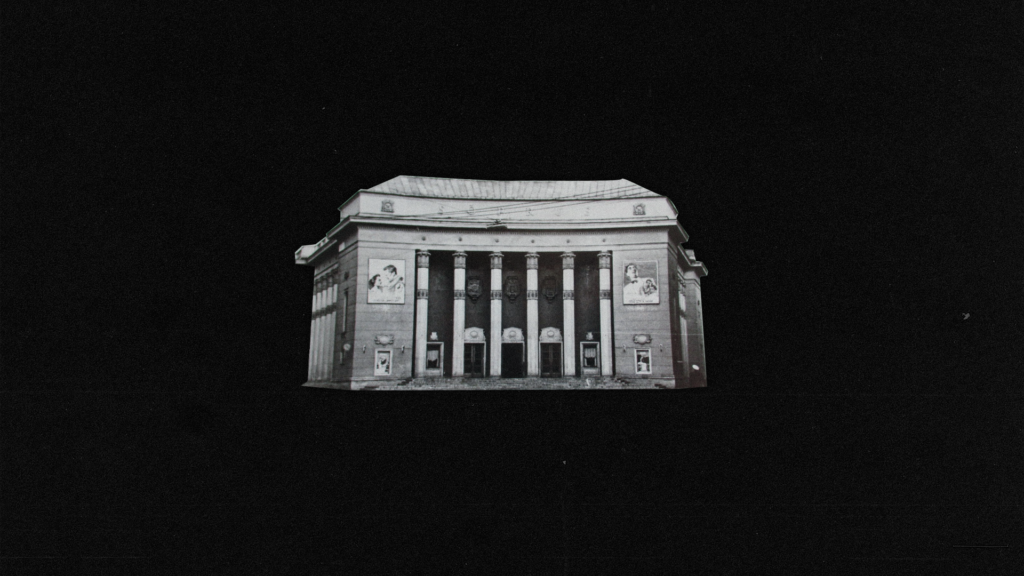
May 7, 1945
In Moscow, an order was issued by the Soviet Union’s Cinema Administration to establish model cinemas.
1948
A decision was made to build a cinema palace with three halls. Later, the number of halls was reduced to two. Sõprus became Estonia’s first multiplex cinema.
1950
The building began to be designed by architect Friedrich Wendach. The core principles of the building originate from him: a curved exterior form and colonnade, halls accommodating 400 viewers, their layout, as well as the placement of the foyer and staircases.
1950–1952
Design work began for a new cinema on the site of buildings destroyed in the March 1944 bombing.
The cinema was initially proposed to be named Leningrad or Spartacus. However, as a result of the warming relations between the People’s Republic of China and the Soviet Union, it ultimately received the name Sõprus.
1953
Nearly one million rubles were allocated for the construction of Sõprus.
This amounted to almost one third of the total funding designated for the development of the cinema network in the Estonian SSR. Cinemas were also planned in Keila, Tõrva, Jõhvi, and Paldiski. The foundation pit was dug during winter. The frozen ground, along with old stone and reinforced concrete structures found within it, was partly blasted and partly cut manually or with machines. The slow progress of construction was attributed to the exceptionally difficult soil conditions, limited mechanisation of excavation work, and the resulting need for manual digging. There was also a shortage of workers.
May 15, 1955
The cinema opened with the film Mikhail Lomonosov, directed by A. Ivanov and M. Shapiro, marking the 200th anniversary of Moscow University.
Now there was a place to host exhibitions of Soviet film posters, rest in the buffet, and meet filmmakers. The building also featured a spacious exterior façade where giant film advertising banners could be displayed.
1970
The late 1970s marked the peak of Russian cinema at Sõprus.
During this time, the film Moscow Does Not Believe in Tears won the Academy Award for Best Foreign Language Film. The cast was also very strong. At times, ticket queues stretched along Suur-Karja Street all the way to the Ararat shop. This was understandable, as during the Soviet era there were very few entertainment options available for middle-class youth.
1995
The second cinema hall was closed due to economic difficulties, and a nightclub and casino moved into the building. A major reconstruction took place, transforming the cinema building into an entertainment complex with multiple separate spaces. Nightclubs and bars still operate in the building today, and only one hall remains in use as a cinema.
2004
Sõprus was reopened as an arthouse cinema, operated by AS Tallinnfilm. The collection of films produced by Tallinnfilm between 1941 and 2001 constitutes the majority of Estonia’s film heritage, including well-known national classics such as Kevade and The Last Relic. In total, Tallinnfilm’s catalogue includes around 850 films, along with numerous newsreels and documentary shorts.
2009
At the end of the year, AS Tallinnfilm moved to Kino Artis, and regular screenings at Sõprus were discontinued. A fountain was finally opened in front of the cinema, as had originally been planned in 1955.
2010
The operation of the cinema was taken over by MTÜ Must Käsi.


